Sri Lanka works in three languages, and most people switch between them every day. A shop notice may need Sinhala, Tamil and English versions. A parent wants to understand an English school circular. A business replies to customers in the language they wrote in. AI translation has improved enormously, and tools that once produced word-for-word nonsense now give readable Sinhala and Tamil. They still make mistakes that matter, though, especially with tone, formal language, names and local terms. This guide compares the main tools for Sinhala and Tamil in 2026, shows where each one works best, and gives a simple process for translations you can rely on.
Key points
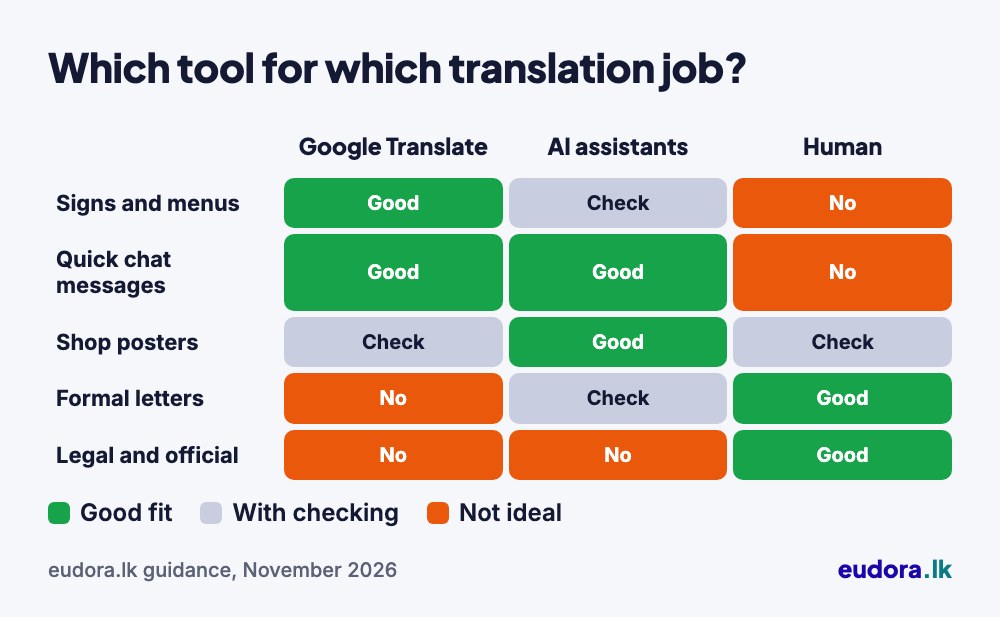
- Google Translate is the quickest for short text, signs and conversations, and works offline with downloaded languages.
- AI chat assistants such as ChatGPT, Gemini and Claude handle context and tone better, and can explain their choices.
- All tools struggle with formal and official language, names, idioms and mixed Sinhala-English or Tamil-English writing.
- Local tools such as Dialog’s trilingual AI and research models like SinLlama are emerging, focused on Sri Lankan languages.
- Anything legal, medical, official or published should be checked by a fluent person.
The tools compared
| Tool | Best for | Strengths | Weaknesses |
|---|---|---|---|
| Google Translate | Quick phrases, signs, menus, conversations | Fast, camera and voice modes, offline packs | Literal; misses tone and context |
| ChatGPT | Letters, messages, explanations | Understands context; can adjust tone and explain | Can sound unnatural; occasional errors |
| Gemini | Messages, documents, Google users | Context-aware; built into Android | Similar quality issues in long text |
| Claude | Longer documents | Careful with long text and instructions | Less familiar to local users |
| Local AI tools | Everyday Sinhala and Tamil questions | Built with local languages in mind | Newer; independent testing limited |
Independent evidence on Sinhala and Tamil quality is limited. A 2025 study by Democracy Reporting tested several chatbots in English, Sinhala and Tamil on election questions and found differences between tools in accuracy and balance, and local reporting in 2026 noted that answers in Sinhala can sometimes be broken or repetitive. Our own experience matches that picture: quality is good enough for everyday use, but not yet reliable enough to publish without checking.
Where AI translation goes wrong
| Problem | Example of what happens | How to avoid it |
|---|---|---|
| Wrong level of formality | A letter to a government office sounds casual | Tell the AI the reader and the formality needed |
| Literal idioms | English sayings translated word for word make no sense | Ask for natural local phrasing, not literal translation |
| Names and places | Personal names or town names altered or translated | Give names in both scripts and ask to keep them unchanged |
| Technical terms | Terms differ from those used in schools or offices | Provide a list of preferred terms |
| Mixed language | Singlish or Tanglish messages misread | Rewrite the message clearly before translating |
| Numbers and dates | Dates, prices or units changed | Check every number against the original |
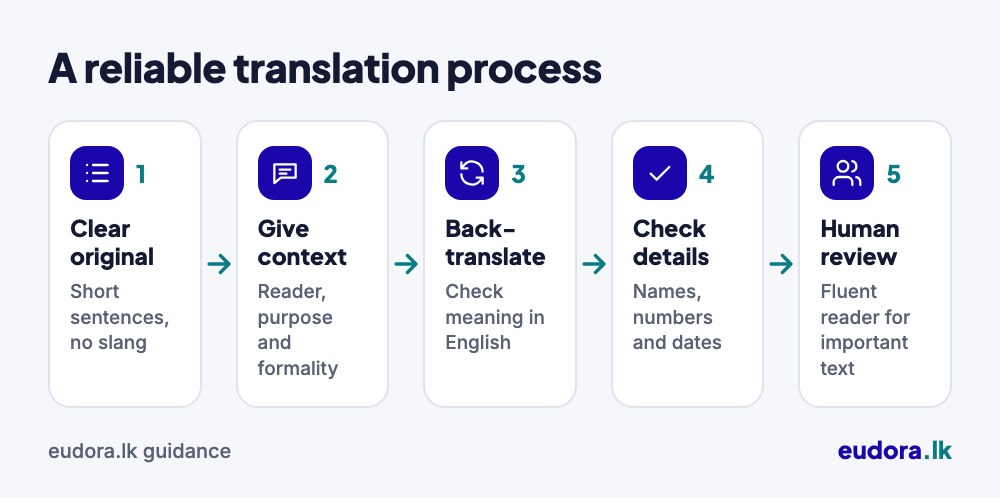
A reliable translation process
- Write a clear original. Short sentences, no slang. Good translations start with good source text.
- Give context. “Translate this notice for customers of a family electronics shop into polite, simple Sinhala.”
- Ask for a back-translation. Ask the AI to translate its own version back into English, and check the meaning has not changed.
- Check names, numbers and dates line by line.
- Have a fluent person read it for anything published, official or important.
Tip: For shop posters and social media, ask the AI for two or three Sinhala and Tamil versions and choose the one that sounds most natural to you and your staff.
Using AI translation in everyday life
For travellers and families, Google Translate’s camera mode is the most practical feature: point the phone at a sign, a medicine label or a form and see the translation on screen. Conversation mode lets two people speak in different languages with the phone translating aloud, which helps with tourists in a shop or relatives abroad. Download the Sinhala and Tamil language packs for offline use before travelling or during poor connections.
AI assistants are better when you need understanding rather than word-for-word translation. Paste an English school circular or bank letter and ask, “Explain this in simple Sinhala and tell me what I need to do and by when.” That kind of explanation is often more useful than a literal translation. Our comparison of ChatGPT, Gemini, Claude and Copilot covers the assistants in more detail.
Voice translation and live conversations
Voice features have improved quickly. Google Translate’s conversation mode listens to each speaker and reads the translation aloud, and the voice modes in ChatGPT and Gemini can act as an interpreter if you ask them to translate everything you say between two languages. For a shop serving tourists, a hotel reception or a family call with relatives who speak another language, this is genuinely useful. Speak slowly, in short sentences, in a quiet place, and confirm important details such as prices, times and addresses by writing them down or showing them on screen.
Voice translation works less well with strong regional accents, fast speech and mixed-language sentences. For hospital visits, police matters or legal discussions, ask for a human interpreter.
Sinhala and Tamil are not equally covered
Tamil benefits from a large worldwide community of speakers and a great deal of online text, much of it from India, so AI tools often handle written Tamil fluently. The catch is that Sri Lankan Tamil differs from Indian Tamil in vocabulary, spelling preferences and expressions, and AI output may lean towards Indian usage. Sinhala has far less online text, which is one reason its quality varies more. For customer-facing Tamil, ask the AI to use Sri Lankan Tamil and have a local speaker check the result.
Students and parents
Students often use AI to translate English study material into Sinhala or Tamil, or the other way round. Explanations are usually more helpful than direct translation: ask the AI to explain a paragraph in simple Sinhala, then compare the key terms with your textbook, because technical terms in AI output may differ from those used in Sri Lankan schools. Our guide to AI study tools for students covers this in more detail.
For businesses
Customers notice poor translations, and a notice in awkward Sinhala or Tamil can make a business look careless. AI makes it realistic for small businesses to communicate in all three languages, provided someone checks the result.
- Social media and posters: AI drafts in three languages, checked by staff, then text added in a design tool using proper Unicode fonts.
- Website content: translate key pages, but keep the structure simple and review each page.
- Customer messages: AI helps you reply in the customer’s language; keep personal details out of free tools.
- Contracts, warranties and legal notices: use a professional translator.
Our guide to AI tools for small shops has more practical examples, and our website design team can build multilingual sites that display Sinhala and Tamil correctly.

Typing and fonts
Translation is only half the job; the text also has to display correctly. Use Unicode Sinhala and Tamil, which every modern phone, computer and website supports, rather than older non-Unicode fonts that turn into nonsense on other devices. Windows, Android and iPhones all include Sinhala and Tamil keyboards, and Google’s input tools allow phonetic typing in English letters. When AI generates images, add Sinhala or Tamil text separately in a design tool, because image models often misspell non-Latin scripts.
Local and emerging tools
Sri Lankan organisations are building AI with local languages in mind. Dialog launched a trilingual generative AI platform for Sinhala, Tamil and English in July 2025, and researchers at the University of Moratuwa developed SinLlama, an open model adapted for Sinhala. Local tools can handle Sri Lankan names, places and expressions better, though independent comparisons are still limited. It is worth testing them alongside the global tools for your own tasks.
For businesses that publish in all three languages regularly, a small glossary helps more than any tool. List your product names, service names and key phrases with the approved Sinhala and Tamil versions, and paste it into the AI prompt each time. Translations then stay consistent across posters, posts and the website.
Privacy when translating
Translation tools see everything you paste into them. Avoid putting identity numbers, medical results, legal documents or customer data into free tools, or remove the personal details first. Our guide to AI privacy settings shows how to stop your text being used for training in each app.
Frequently asked questions
Which is the best AI for Sinhala translation?
For short phrases, Google Translate is quick and reliable. For letters and messages where tone matters, ChatGPT or Gemini usually give more natural results. Always check important text.
Can AI translate official documents?
It can help you understand them, but official translations for courts, embassies or government offices need a qualified human translator.
Does Google Translate work offline for Sinhala and Tamil?
Yes, after downloading the language packs in the app.
Why does AI Sinhala sometimes sound strange?
AI models learned mostly from English text and less from Sinhala and Tamil, so phrasing can be unnatural or too literal. Quality is improving with each release.
Can AI help me reply to customers in Tamil?
Yes. Draft the reply with AI, check names and numbers, and keep personal customer details out of free tools.

Eudora Technology is a Kandy-based team working on CCTV, networks, IT support, cloud and websites for homes and businesses across Sri Lanka.