5G in Sri Lanka: What It Means for Your Phone, Home Internet and Business
Dialog and SLT-Mobitel switched on commercial 5G after the December 2025 spectrum auction. What changed, where it works, and whether you need a 5G phone or router yet.
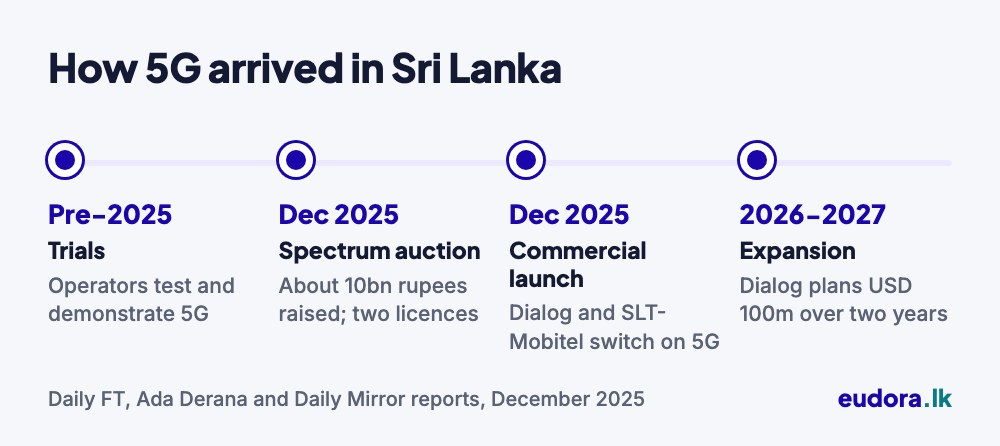
Sri Lanka joined the 5G era at the end of 2025. After a spectrum auction in December, Dialog Axiata and SLT-Mobitel received licences and launched commercial 5G services, with Dialog announcing a network of more than 220 sites at launch. A year later, the questions we hear most are practical: will 5G make my internet faster, do I need a new phone, should a shop or office switch from fibre or 4G, and is it worth buying a 5G router now? This guide sets out what has happened, how 5G differs from 4G, and what makes sense for homes and businesses in 2026.
Key points
- Sri Lanka’s 5G auction in December 2025 raised about 10 billion rupees. Dialog and SLT-Mobitel won licences; Hutch did not bid.
- Each operator received 100MHz in the 3.5GHz band, and Dialog also took 200MHz of millimetre-wave spectrum at 27GHz.
- Coverage started in cities and is expanding. Outside those areas, phones fall back to 4G automatically.
- For most homes, fibre is still the best fixed connection. 5G is a strong alternative where fibre is unavailable, and 4G routers remain a useful backup.
What happened: licences and launch
The Telecommunications Regulatory Commission auctioned 5G spectrum in December 2025. According to reports in the Daily FT and Ada Derana, the government raised about 10 billion rupees, with Dialog Axiata and SLT-Mobitel the only bidders. Hutch did not take part.
| Operator | 3.5GHz spectrum | Other 5G spectrum | Launch notes |
|---|---|---|---|
| Dialog Axiata | 3400 to 3500MHz (100MHz) | 27.2 to 27.4GHz (200MHz) | Launched as Dialog 5G Ultra with over 220 sites; committed USD 100 million over two years |
| SLT-Mobitel | 3500 to 3600MHz (100MHz) | None reported | Launched commercial 5G alongside its 4G network |
The 3.5GHz band is the main 5G band used around the world. It offers a good balance of speed and range. The 27GHz millimetre-wave band can carry very high speeds but only over short distances, and it is usually used for dense areas, stadiums or fixed wireless links rather than general coverage.
How 5G differs from 4G
5G is not just a faster version of 4G. It uses wider radio channels, more advanced antennas and a different network design. The differences that matter to users are speed, capacity and latency, the delay before data starts to flow.
| Feature | 4G LTE | 5G at 3.5GHz |
|---|---|---|
| Typical channel width | Up to 20MHz per carrier | Up to 100MHz per operator |
| Speed in good coverage | Tens of Mbps, sometimes more | Often several hundred Mbps |
| Capacity in busy areas | Slows at peak times | Much more headroom |
| Latency | Moderate | Lower, especially on standalone 5G |
| Range from a tower | Longer | Shorter; more sites needed |
| Indoor coverage | Better through walls | Weaker indoors, improving with more sites |
The biggest practical benefit is capacity. In busy parts of Colombo or Kandy town where 4G slows down in the evening, 5G spreads the load across far more spectrum. Speeds you see depend on your distance from the site, how many people are using it, your phone or router, and your data package.
Do you need a 5G phone?
Only if you are in or regularly visit an area with 5G coverage and want faster mobile data. Many mid-range and flagship phones sold since about 2021 already support 5G, though not every model supports every band, so check that your phone covers the n78 band, which includes 3.5GHz. Your operator may also need to enable 5G on your SIM or package.
- Check your phone’s settings for a 5G network mode.
- Check your operator’s coverage map for your home, work and commute.
- Ask whether your current package includes 5G or needs an upgrade.
- Keep in mind that 5G can use more battery in areas with weak coverage, where the phone keeps searching.
5G for home internet
For home and office broadband, there are three main options in Sri Lanka: fibre, 4G home routers and, now, 5G fixed wireless in covered areas.
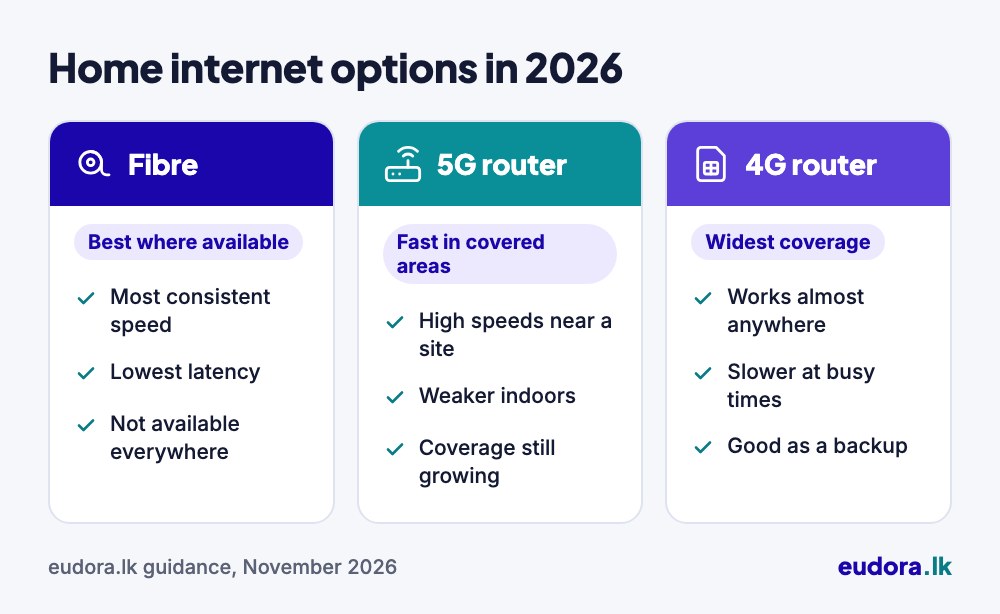
Fibre remains the best fixed connection where it is available. It is not shared with mobile users in the same way, it has low latency, and it does not depend on signal strength indoors. Where fibre is not available, as in many parts of the hill country and rural areas, a 4G or 5G router is the alternative. Our guide to 4G routers for internet without fibre explains how to get the best signal, and the same principles apply to 5G: place the router high, near a window facing the nearest tower, and consider an external antenna if the signal is weak.
Note: 5G signals at 3.5GHz pass through walls less easily than 4G. A 5G router in the middle of a concrete house may perform no better than a 4G router by the window.
What businesses should do
For shops and offices, 5G is most useful in three roles: as a primary connection where fibre is slow or unavailable, as a backup when the main line fails, and for temporary sites such as events and construction projects. A backup internet line matters more than ever because card payments, cloud accounting, WhatsApp orders and CCTV viewing all depend on it.
- Keep fibre as the main line where you have it.
- Add a mobile backup on a different operator from your fibre provider, so one outage does not take down both.
- Use a router that can fail over automatically, or set up a separate backup router for essential devices.
- Put routers on a UPS, because power cuts are a more frequent cause of outages than line faults.
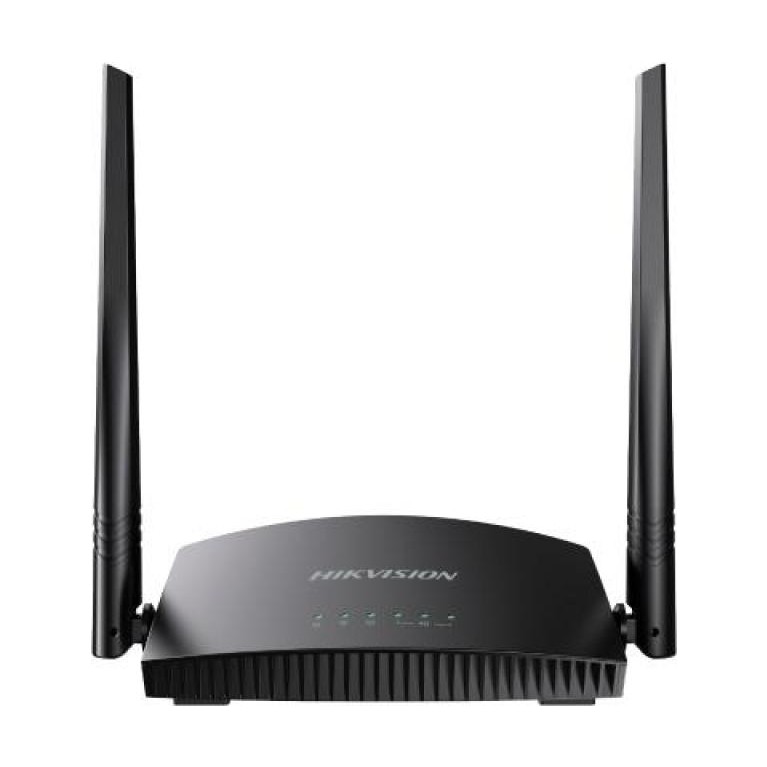
A 4G router remains a cost-effective backup today, and 4G coverage is far wider than 5G. A Hikvision 4G router with our router setup service costs Rs 22,900. As 5G coverage grows, 5G routers will become a better primary option for more locations. Our UPS guide explains how to keep routers running through power cuts.
CCTV, sensors and remote sites
Mobile data is also what keeps cameras and sensors online where there is no fixed line: farms, estates, construction sites, holiday bungalows and shops in new developments. Today that is usually done with 4G cameras or a 4G router feeding a small recorder, and our guide to 4G and solar cameras for remote sites explains the set-up. 5G adds more upload capacity, which matters for cameras because they send video up to the cloud or your phone rather than download it.
For most remote CCTV, though, 4G is still the practical choice in 2026 because it reaches far more places and the cameras and routers cost less. Recording locally on a memory card or recorder and only streaming when you check in keeps data use, and the monthly bill, under control.
Data packages and what to watch
Faster connections use data faster. Streaming video in higher quality, automatic phone backups and large app updates can consume a package much quicker on 5G than on 4G. Before switching, check your operator’s 5G package terms: whether the data quota is shared with 4G, whether there are night-time or app-specific allowances, and what happens when the quota runs out. For a home router replacing fibre, an unlimited or large-quota home broadband package is usually better value than a mobile package.
What about Wi-Fi inside the building?
A fast 5G connection does not help if the Wi-Fi inside the house is weak. Many complaints about slow internet are actually Wi-Fi problems: an old router, interference, or a signal that cannot reach upstairs rooms. Our slow Wi-Fi troubleshooting guide helps you tell the difference, and a modern dual-band router or mesh system often makes more difference to daily use than the connection type.
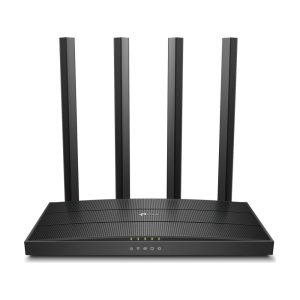
Finally, remember that the router is only as good as its position. Moving a mobile router from a back room to a first-floor window often improves speeds more than changing operator or upgrading the package, so try that first.
Health and safety questions
We are often asked whether 5G is safe. Mobile networks, including 5G, operate within international exposure limits set by bodies such as the International Commission on Non-Ionizing Radiation Protection, and the WHO states that no adverse health effect has been causally linked with exposure to wireless technologies within those limits. The 3.5GHz band used for 5G is close to frequencies already used for Wi-Fi and earlier mobile networks.
If you would like help choosing between fibre, 4G and 5G for a home or office, or setting up a backup link, our networking team can survey the signal on site and recommend the right equipment.
Frequently asked questions
Which operators offer 5G in Sri Lanka?
Dialog and SLT-Mobitel received 5G licences after the December 2025 auction and launched commercial 5G services. Coverage is expanding from city areas.
Will my 4G phone stop working?
No. 4G networks continue to operate, and 5G phones fall back to 4G outside 5G areas.
Is 5G faster than fibre?
In good coverage 5G can match or exceed many fibre packages for download speed, but fibre is usually more consistent, has lower latency and is not affected by indoor signal or busy cells.
Should I buy a 5G router now?
If you live or work where 5G coverage is strong and fibre is not available, it can be worthwhile. Elsewhere, a good 4G router is cheaper and works in more places.
Which 5G band is used in Sri Lanka?
The main band is 3.5GHz, known as n78. Dialog also holds millimetre-wave spectrum at 27GHz. Check that your phone or router supports n78.

Eudora Technology is a Kandy-based team working on CCTV, networks, IT support, cloud and websites for homes and businesses across Sri Lanka.