Sri Lanka’s Digital ID (SL-UDI) Explained: What Changes and How to Stay Safe
Sri Lanka's Unique Digital Identity is starting its phased rollout. What SL-UDI is, who gets it first, what it means for banking and business, and the scams to avoid.
For decades, proving who you are in Sri Lanka has meant showing a National Identity Card, filling in paper forms and making photocopies for banks, telecom shops and government offices. The Sri Lanka Unique Digital Identity programme, usually shortened to SL-UDI, aims to change that by giving each citizen a secure digital identity that can be verified electronically. After several years of planning, funded largely by a grant from the Government of India, the programme is moving into its first phase of rollout. It promises faster access to services and easier banking, but it also raises fair questions about privacy and security, and it will inevitably attract scammers. This guide explains what SL-UDI is, what is known about the rollout, how it may affect everyday life and business, and how to protect yourself.
Key points
- SL-UDI is a national digital identity system that links a unique identity number with biometric and demographic data for secure electronic verification.
- The rollout is phased, with first digital identities and new e-NICs expected from the final quarter of 2026, starting with young people receiving their first identity cards.
- Existing NICs remain valid during a transition period reported at three to five years.
- Banks and businesses expect easier customer onboarding and better access to credit, especially in rural areas.
- Use only official channels; never share identity details, OTPs or biometrics with anyone who contacts you offering help.
What SL-UDI is
A digital identity is a way to prove who you are electronically, as reliably as showing an identity card in person. SL-UDI combines a unique identity number with a citizen’s core demographic details and biometric information, held in a secure national system. When you use a service that accepts SL-UDI, the service can verify your identity electronically, with your consent, instead of relying on photocopies and manual checks. Reports describe an e-Locker component for storing and sharing official documents digitally.
The project is funded mainly through a grant worth about 10.4 billion rupees from the Government of India, and has drawn on India’s experience with its own digital identity system. Implementation is being handled in phases, with a sandbox for testing and attention to security and privacy standards, according to reports during 2026.
The rollout timeline so far
The timetable has moved more than once, which is normal for national identity projects. Reporting in early 2026 pointed to a launch in the third quarter; by September 2026 the target had shifted to the final quarter, with first production identities and new e-NICs that include an SL-UDI number issued to 16-year-olds receiving their first identity cards. Wider enrolment is expected to follow in phases over the next few years.
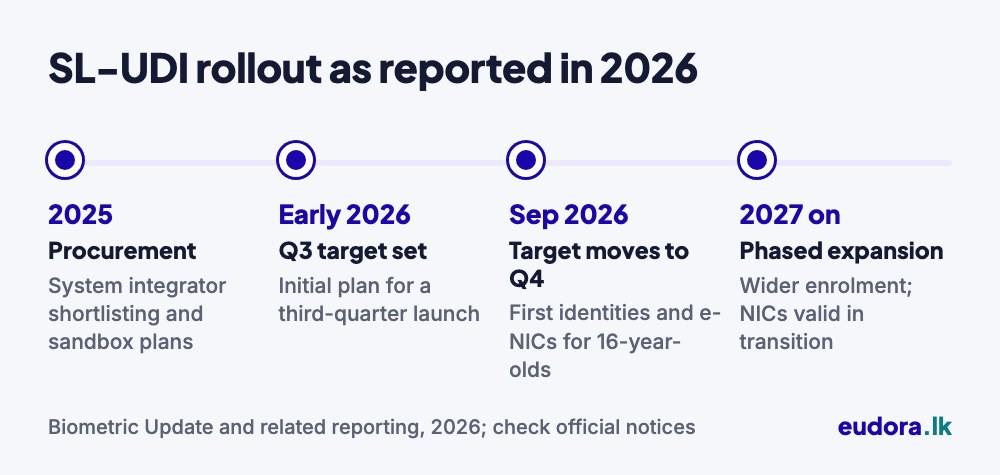
| Stage | What is expected | What you need to do |
|---|---|---|
| Planning and procurement | System design, contractor selection, sandbox testing | Nothing |
| First phase (from Q4 2026) | First digital identities; e-NICs with SL-UDI numbers for 16-year-olds | Follow official instructions if a family member is turning 16 |
| Expansion | Wider enrolment and services accepting SL-UDI | Enrol through official channels when invited |
| Transition (three to five years) | Existing NICs remain valid alongside SL-UDI | Keep your NIC; no need to rush |
Because details can change, rely on official government announcements and the Department for Registration of Persons for instructions, not social media posts or messages.
What it could change for everyday life
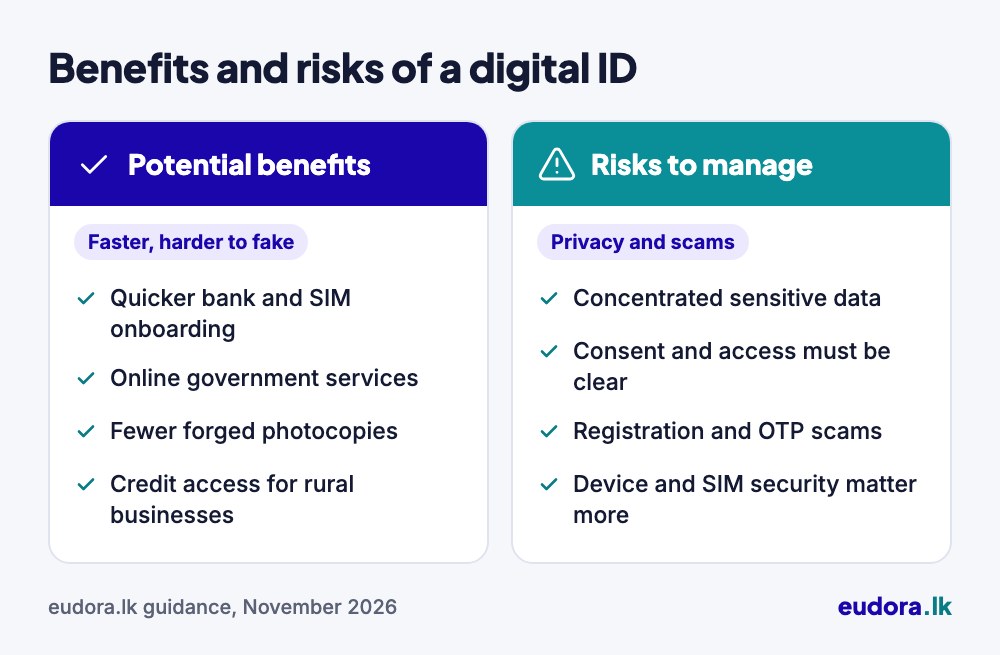
- Banking: opening accounts and applying for loans with electronic identity checks instead of piles of photocopies.
- Government services: applying for certificates, permits and benefits online with verified identity.
- Telecoms: SIM registration and replacement with stronger identity checks, which can also reduce SIM-swap fraud.
- Documents: receiving and sharing official documents through a digital locker rather than paper copies.
- Fewer forged documents: electronic verification is harder to fake than a photocopy.
What it means for businesses
Banks have been among the most enthusiastic supporters. In November 2026, the chief executive of one major bank described how combining biometric identity verification with consent-based access to financial and business records could help banks assess and lend to rural entrepreneurs who lack collateral or formal paperwork. Microfinance, insurance, telecoms and e-commerce businesses could similarly onboard customers faster and with less fraud.
Any business that handles identity data will also take on responsibility for protecting it. Sri Lanka’s Personal Data Protection Act, whose core rules are expected to apply from 1 January 2027, requires businesses to collect only what they need, keep it secure and use it fairly. Identity numbers and biometric data deserve the highest level of care. Our guide to the PDPA’s 2027 start explains the basics, and our article on where cloud data is stored covers data held abroad.
Privacy and security questions
Any national identity system concentrates sensitive data, so it is reasonable to ask how it is protected. Officials have described a phased approach intended to meet security and privacy standards, consent-based sharing, and testing before wide rollout. Citizens and civil society will rightly watch how consent works in practice, who can access data, how access is logged and how errors are corrected. Data breaches in digital identity systems elsewhere have shown that strong security and independent oversight matter. As the system develops, look for clear information on what data is held, who can see it, and how to view the record of who has accessed your identity.
How electronic verification works
When a service checks a digital identity, it does not usually need to see everything held about you. A well-designed system answers a specific question, such as whether this person is who they claim to be, or whether they are over eighteen, after you give consent, often by a fingerprint, a one-time code or approval on your phone. The service receives a confirmation and the minimum details it needs, and the check is recorded. This is very different from today’s practice of handing over a photocopy that shows your full name, number, address and photo to anyone who asks, and that copy then sits in a file for years. Done well, digital verification should reduce how much identity data is scattered around.
The scams that will follow
Every major identity change brings scammers. Expect fake messages and calls offering to “register you early”, “update your NIC” or “link your SL-UDI to your bank”, fake websites asking for NIC numbers, photos of identity cards, selfies or OTPs, and fake agents asking for fees. Use only official government channels, and remember that no legitimate service will ask you to share an OTP, PIN or password by phone or message.
Warning: Never send a photo of your NIC, a selfie holding it, or any verification code to someone who contacts you about the digital ID. These are exactly what criminals need to open accounts or SIMs in your name.
Protect your phone and accounts too, since a digital identity is only as safe as the devices used with it. Turn on two-factor authentication or passkeys for email and WhatsApp, keep your phone updated and use good security software. ESET HOME Security Premium at Rs 4,300 and Kaspersky Premium at Rs 4,200 include protection against phishing websites and a password manager. Our guides to online scams in Sri Lanka and passkeys for everyday accounts explain more.

How to prepare
- Keep your NIC safe and current: make sure your details are correct, and report a lost card promptly.
- Follow official sources: rely on government announcements for enrolment instructions.
- Secure your phone number: your mobile number is often used for verification codes, so protect your SIM with a PIN and watch for unexpected loss of signal.
- Teach family members: especially older relatives and teenagers receiving their first identity cards, who may be targeted.
- Businesses: review how you collect and store customer identity copies today, and plan to reduce them.
If you think your identity details have been misused, for example a SIM or loan you did not apply for, report it to the police and the organisation involved immediately, and keep a record of every call and message.
For businesses holding identity copies today
Many shops, landlords, finance companies and employers keep photocopies of NICs in files or phone galleries. That is risky now and will be harder to justify under data protection rules. Keep identity copies only where you genuinely need them, store them securely with limited access, delete them when no longer required, and plan to move to electronic verification as it becomes available. Our cybersecurity team can review how you store customer data, and our small business security check costs Rs 24,900.

Frequently asked questions
What is SL-UDI?
Sri Lanka Unique Digital Identity, a national system for verifying identity electronically using a unique number linked to demographic and biometric data.
Do I need to replace my NIC now?
No. Existing NICs are expected to remain valid during a transition period of several years. Follow official instructions when enrolment opens for you.
Who gets it first?
The first phase is expected to start with young people receiving their first identity cards, with wider rollout later.
Will banks use it?
Banks expect to use it for faster account opening and better credit assessment, with customer consent.
How do I avoid digital ID scams?
Use only official channels and never share your NIC photo, OTPs, PINs or selfies with anyone who contacts you.

Eudora Technology is a Kandy-based team working on CCTV, networks, IT support, cloud and websites for homes and businesses across Sri Lanka.