Robot Vacuum Buying Guide 2026: Features That Matter in Sri Lankan Homes
Robot vacuums now map rooms, mop floors and empty themselves. Which features are worth paying for in a Sri Lankan home, and what the 2026 market data shows.
Robot vacuums have gone from novelty to normal household appliance. The 2026 models map your home with lasers or cameras, avoid socks and cables, mop tiled floors and, on higher-end versions, empty their own dust bins into a base station. The market is growing fast: industry analyst IDC counted about 11.2 million household cleaning robots shipped worldwide in the second quarter of 2026 alone, up about a fifth on a year earlier. Prices and features vary enormously, though, and the features that sell robots in American carpeted homes are not always the ones that matter on tiled floors in Sri Lanka. This guide explains what to look for.
Key points
- Navigation is the biggest difference between cheap and good robots. Laser (LiDAR) or camera mapping cleans in neat rows; basic models bump around randomly.
- Most Sri Lankan homes have tiled or cement floors, where a robot with a good mopping function is very useful.
- Self-emptying bases and mop washing stations add convenience but also cost, size and consumables.
- Fine dust, humidity and pet hair mean brushes and filters need regular cleaning.
What the 2026 market looks like
IDC’s figures show how quickly the category is growing. In the first quarter of 2026 it counted about 8.94 million household cleaning robots shipped worldwide, up 36.7% on a year earlier, of which about 6.56 million were robot vacuums. In the second quarter, shipments of all household cleaning robots reached about 11.2 million, up 21.5%, with robot vacuums at roughly 7.9 million units.

The market has also consolidated. IDC reported that the top five brands accounted for about 75% of robot vacuum shipments in the second quarter of 2026, with Chinese makers such as Roborock and Dreame leading after the decline of iRobot, the company that popularised the category with the Roomba. For buyers, that means more capable features at lower prices, but also that some smaller brands may disappear, which matters for spare parts and app support.
Navigation: the feature that matters most
How a robot finds its way around decides how well and how quickly it cleans.
| Navigation type | How it works | Cleaning pattern | Best for |
|---|---|---|---|
| Random or bump | Bumps into obstacles and turns | Random; may miss areas | Single small rooms on a tight budget |
| Gyroscope | Tracks movement with motion sensors | Rows, but drifts over time | Small flats |
| Laser (LiDAR) | Spinning laser maps the room | Neat rows, full map, works in the dark | Most homes |
| Camera (vSLAM) | Camera recognises the room’s features | Neat rows; needs some light | Homes with good lighting |
| Laser plus front camera or 3D sensor | Maps and recognises obstacles | Neat rows; avoids cables, socks, pet mess | Busy family homes and pet owners |
A mapping robot lets you divide the house into rooms in the app, set no-go zones around a pet’s water bowl or a shrine, and clean just the kitchen after dinner. For a multi-room house it is the single most worthwhile upgrade.
Vacuuming and mopping on Sri Lankan floors
Many robot vacuum reviews focus on carpets. Most Sri Lankan homes have tiled, terrazzo, cement or polished floors with a few rugs, which changes the priorities. Suction power still matters for fine dust and sand that blow in through open windows and doors, but mopping becomes far more useful.
- Basic mopping drags a damp cloth behind the robot. It picks up light dust but does not scrub.
- Vibrating or rotating mops press down and scrub, removing footprints and light stains.
- Mop lifting raises the mop when the robot reaches a rug so it does not wet it.
- Washing and drying bases clean the mop pads automatically, which matters in humid weather when damp pads can smell.
Tip: In humid weather, a mop pad left damp in the robot can start to smell within a day. Remove and dry pads after each mopping run unless the base dries them for you.
Bins, bases and batteries
A robot’s dust bin is small and fills quickly with sand and hair. Self-emptying bases suck the bin contents into a larger bag, so you only empty the base every few weeks. They are convenient but add cost, need replacement bags and take floor space near a socket.
Battery life decides how much floor a robot can cover in one run. A mapping robot that runs out of charge usually returns to its base, recharges and carries on where it left off, which is fine for larger houses. Random-navigation robots often cannot resume, so they suit smaller spaces. Power cuts matter too: the robot itself runs on battery, but the base needs mains power to charge, so a scheduled clean may be skipped if the power was off.
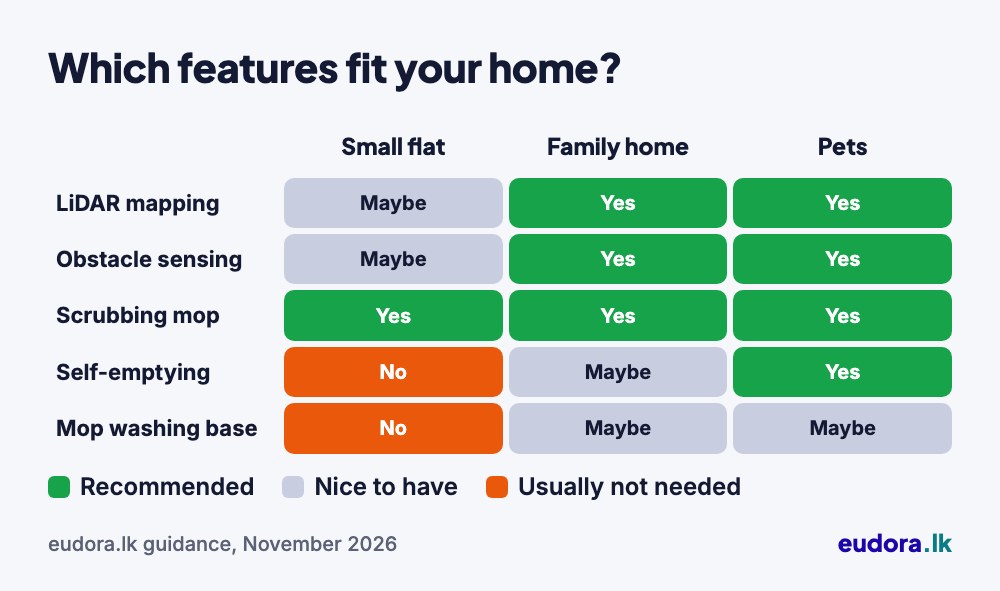
| Feature | Worth paying for if | Can skip if |
|---|---|---|
| LiDAR mapping | You have more than two rooms | You clean one small room |
| Obstacle recognition | Children’s toys, cables or pets on the floor | Floors are usually clear |
| Scrubbing mop | Mostly tiled floors | Mostly carpet |
| Self-emptying base | Pets, long hair or daily cleaning | Small home, occasional use |
| Mop washing base | Daily mopping in a large home | Mopping once or twice a week |
How much to spend
Robot vacuums span a wide price range, and the jump in usefulness is not evenly spread. Moving from a basic random-navigation robot to one with laser mapping is the biggest step up for most homes, because it turns a robot that wanders into one that cleans every room methodically and can be told where to go. Beyond that, each extra, such as obstacle recognition, a scrubbing mop or an automatic base, adds convenience rather than cleaning quality.
A sensible approach is to decide which jobs you most want to stop doing yourself. If daily sweeping of sand and dust is the chore, a good mapping vacuum is enough. If wet mopping takes your time, prioritise a scrubbing mop with mop lifting. If emptying the bin every day would put you off using it, look at self-emptying models. Buying the features you will use, rather than the longest specification list, gives the best value.
Warranty and local support are part of the price too. A robot has motors, brushes and a battery that wear, so ask how repairs are handled and whether parts are stocked in Sri Lanka before you buy.
Pets, hair and dust
Long hair and pet fur wrap around brushes and slow the robot down. Rubber or tangle-resistant brushes help, as do models with an angled or twin brush design. Fine dust from nearby roads or construction sites clogs filters quickly, so check that replacement filters and brushes are easy to buy. Ask about spare parts before you buy, not after the first brush wears out.
If you have pets, obstacle recognition is worth the extra money. Robots that can recognise and avoid pet accidents prevent a very unpleasant job.
Setting up for success
- Place the base against a wall with clear space on each side and in front, near a socket and within good Wi-Fi range.
- Tidy the first run. Pick up cables, small toys and loose rugs with tassels before the robot maps the house.
- Let it map fully with all internal doors open, then name rooms in the app.
- Set no-go zones around pet bowls, shrines, delicate furniture and steps without edges.
- Schedule cleaning for when the house is empty, and check it does not clash with regular power cuts.
Robot vacuums connect over 2.4GHz Wi-Fi in most cases, so a dual-band router with a clear 2.4GHz network avoids pairing problems; our post on 2.4GHz and 5GHz Wi-Fi for smart devices explains why. Many robots also work with Alexa or Google Home, so you can start a clean by voice; see our smart home starter guide for ideas.
Maintenance routine
| How often | Task |
|---|---|
| After each run | Empty the bin (unless self-emptying); dry mop pads |
| Weekly | Cut hair off the main brush; tap out the filter |
| Monthly | Wipe sensors and the charging contacts; clean side brushes and wheels |
| Every few months | Replace filter, side brushes and mop pads as needed |
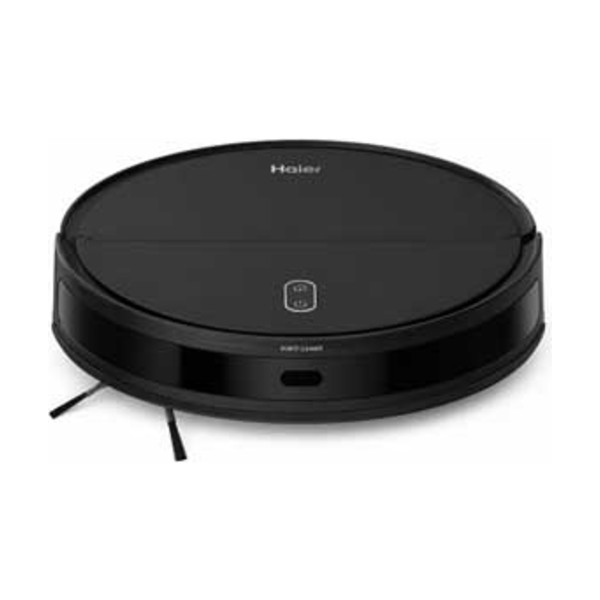
A robot vacuum does not replace an occasional deep clean, especially of corners, stairs and under heavy furniture, but it keeps everyday dust and sand under control. The Haier CIVIC X11 in our range costs Rs 65,800, or Rs 67,300 with our smart device setup, which covers connecting it to Wi-Fi and the app. Our smart home team can advise on other models and on connecting robots, lights and cameras into one routine.
Frequently asked questions
Do robot vacuums work well on tiled floors?
Yes. Tiles, terrazzo and polished cement are ideal surfaces, and models with a scrubbing mop handle the dust and footprints common in Sri Lankan homes well.
Can a robot vacuum climb between rooms with a door step?
Most can climb thresholds of around 2cm, and some higher-end models more. Check the specification if your home has raised door steps.
Will a robot vacuum fall down the stairs?
Robots have cliff sensors that detect drops. They work well on most floors, but very dark floors or shiny edges can confuse them, so test carefully and use a no-go zone if needed.
Is a camera-based robot a privacy risk?
Camera navigation robots process images to find their way. Choose reputable brands, read the privacy settings and keep the app and firmware updated.
How long does a robot vacuum last?
Several years with regular cleaning and replacement of brushes, filters and eventually the battery. Availability of spare parts locally makes a big difference.

Eudora Technology is a Kandy-based team working on CCTV, networks, IT support, cloud and websites for homes and businesses across Sri Lanka.